

AXIA Projects
AXIA Audit
Making Digital Quality Measurable and Actionable
An automated web auditing application that evaluates accessibility, performance, structure, discoverability, and other quality dimensions, transforming technical findings into organized, actionable insights through AI-assisted reporting.
My Role
Creator & End-to-End Product Lead
Project Type
Desktop Application · Web Quality Assessment
Research & Academic Publication
Paper: AXIA Audit: An Automated Web Auditing System with AI-Assisted Report Generation
Authors: Alberto Adán Gómez Alvarado, Juan Luis Villa Cisneros, María de León Sigg
Venue: CIMCIA 2026 · Accepted paper and oral presentation.
The research examines AXIA Audit as a web auditing system that combines automated evaluation with AI-assisted report generation. Its conference acceptance provides an academic context for documenting the system's approach.
A Multidimensional Approach to Web Quality
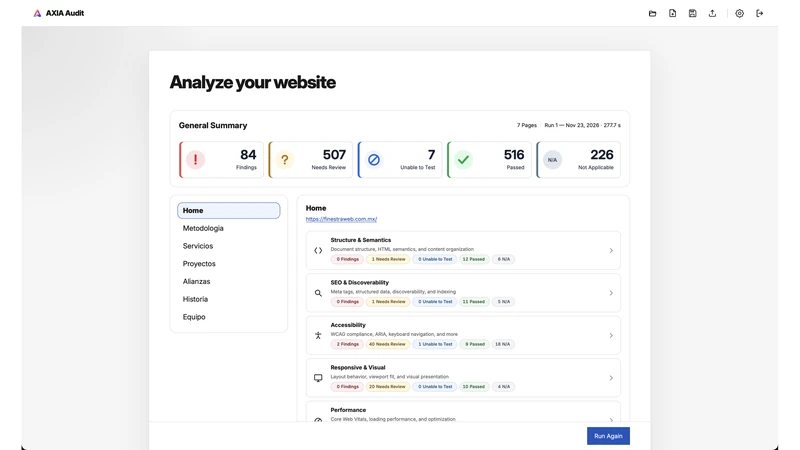
- Structure & Semantics
- SEO & Discoverability
- Accessibility
- Responsive & Visual
- Performance
- Network
- Console & Runtime
- Security / Browser Safety
The categories offer a structured view; they do not equal one global certification score. Browser safety checks are limited to what an automated audit can observe. Accessibility checks are within the stated WCAG 2.2 AA scope, not proof of complete conformance.
Overview
AXIA Audit is an automated web auditing application designed to help identify, organize, and understand quality issues across websites and digital experiences.
The application evaluates multiple aspects of web quality, including accessibility, document structure, search discoverability, responsive behavior, performance, network activity, runtime errors, and browser safety.
Rather than presenting findings as an isolated collection of technical warnings, AXIA Audit organizes evaluation results into meaningful categories, allowing users to explore issues, understand their implications, and prioritize corrective actions.
It also incorporates AI-assisted report generation to translate complex technical findings into structured summaries and recommendations that can support product, design, development, and quality decisions.
The project's accessibility assessment scope includes WCAG 2.2 Level AA.
The Challenge
Web quality is multidimensional. A website may perform well in one area while exhibiting important problems in another.
Accessibility issues, structural inconsistencies, broken resources, performance bottlenecks, and runtime errors can affect different aspects of the user experience, yet they are frequently examined through disconnected tools and reports.
These fragmented results can make it difficult to understand the overall condition of a product, distinguish meaningful problems from less relevant findings, and identify where corrective work should begin.
AXIA Audit was conceived to bring these evaluations into a more cohesive environment, combining automated inspection, structured evidence, and understandable reporting.
The objective is not simply to detect more issues, but to make evaluation results more useful for improving real digital products.
From Automated Checks to Actionable Findings
A central design goal of AXIA Audit is to make automated evaluations useful beyond the moment a check is executed.
The application performs an audit through a Run, collecting findings and supporting information that can be explored within a unified interface.
Results are organized to help users understand where issues occur, what they may affect, and what should be investigated or corrected.
Workflow: Execute a Run · Explore & Filter Findings · Generate Reports · Support Corrective Action.
AI-Assisted Report Generation
One of AXIA Audit's defining capabilities is its integration of AI-assisted report generation.
Automated tools can produce extensive amounts of technical data, but interpreting that information often requires experience across several disciplines.
AXIA Audit uses AI assistance to help organize and explain findings, providing a more accessible narrative of the issues identified during an evaluation.
PDF reporting: Executive summaries; findings organized by quality category; contextual explanations; recommendations supporting investigation/correction; a shareable report suitable for technical and nontechnical stakeholders.
The AI component supports the interpretation and communication of collected evidence. It does not replace the underlying evaluation process or independently certify that a website meets all applicable standards.
Designing the Auditing Experience
AXIA Audit was designed around the challenge of presenting substantial technical information without overwhelming the user.
The experience combines evaluation controls, progress feedback, categorized results, filtering, and reporting within a consistent application interface.
Experience focus: Information Organization · Process Visibility · Result Exploration · Clear Communication.
Particular attention is given to maintaining understandable application states, predictable interactions, and effective navigation through potentially large result sets.
Accessibility & Evaluation Integrity
Accessibility is both an evaluation dimension and an important consideration in the design of AXIA Audit itself.
The application incorporates automated checks within the scope of WCAG 2.2 Level AA while recognizing that automated evaluation cannot determine every aspect of accessibility.
An equally important objective is the reliability of the evaluation process.
Findings should reflect observable conditions and provide sufficient evidence to support investigation. When an unexpected result appears, the appropriate response is to examine its underlying cause, including the possibility of an issue within the auditing system itself.
This approach emphasizes trustworthy evaluation and meaningful improvements rather than treating the number of reported findings as an indicator of effectiveness.
My Contribution
I conceived AXIA Audit and lead its development across product strategy, requirements definition, information architecture, UX/UI design, software development, evaluation logic, quality assurance, and reporting capabilities.
My work includes defining the evaluation experience, organizing its quality dimensions, designing the interface for navigating complex results, and developing the relationship between collected findings and their presentation in structured reports.
The project reflects my experience in user experience design, accessibility, enterprise applications, and software development, bringing these disciplines together to make quality evaluation more comprehensive, understandable, and actionable.
I also contributed to the academic research and publication documenting the system, connecting its practical implementation with a broader discussion of automated quality assessment and AI-assisted reporting.
Outcomes & Ongoing Evolution
AXIA Audit has evolved into a functional auditing application that brings together multiple dimensions of website quality within a unified evaluation and reporting workflow.
The project demonstrates how automated inspection, thoughtful information architecture, and AI-assisted communication can work together to make technical findings more accessible and useful.
Its development has also contributed to an academic publication and conference presentation, extending the project beyond software implementation into research and professional knowledge sharing.
AXIA Audit continues to evolve through refinements to its evaluation engine, improvements to the reliability of its findings, and enhancements to how results are interpreted and communicated.